




NUCLEAR ENERGY · AUTOMATED 24/7 FRONTLINE SHIFT SCHEDULING
10 CFR Part 26 Enforced at Every Assignment. Not Caught in the Annual report.
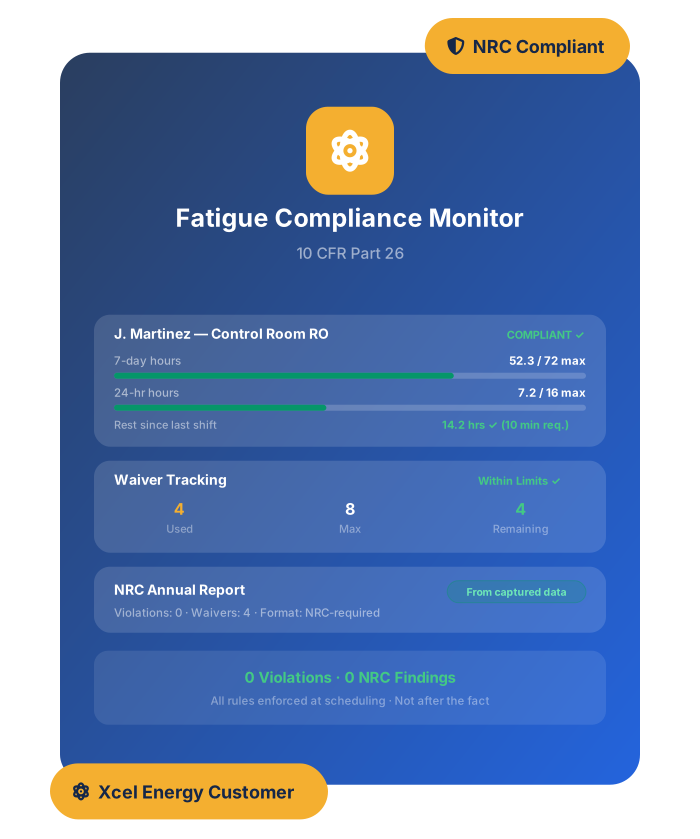
Indeavor automates nuclear worker fatigue management for both online and outage operations — enforcing NRC maximum hour limits, minimum rest periods, and waiver procedures automatically — with annual reports generated in the exact format the NRC requires.
"Xcel Energy is thrilled to work with the specialists at Indeavor for our Worker Fatigue Management solution. Their expertise and dedication has helped create optimized employee schedules and has enabled Xcel's compliance with nuclear fatigue management regulations under 10 CFR Part 26."
— John Truong, Xcel Energy
Trusted by the world's most mission-critical enterprises
NRC civil penalty per significant 10 CFR Part 26 violation
Average cost to replace a nuclear-qualified employee
Savings on variable labor through automation
Hours
NRC annual report generation (vs. weeks manual)
Why is nuclear the most demanding fatigue compliance environment in any industry?
Because 10 CFR Part 26 sets hard work-hour limits, minimum break requirements, and rolling-window rules that apply to every covered worker on every shift — and during a refueling outage the station runs twelve-hour shifts for six weeks straight with hundreds of supplemental workers on site.
A violation found in the annual report is a violation that already happened — and already cost you
When fatigue rules are enforced manually, violations are discovered retroactively — during annual report preparation, months after the violation occurred. The NRC civil penalty for a significant 10 CFR Part 26 violation exceeds $300,000. The public inspection finding travels in every background check run on your plant. Finding violations in the report means they weren't caught at scheduling — the only place they can actually be prevented.
Online mode and outage mode have different rules — and most scheduling tools handle neither
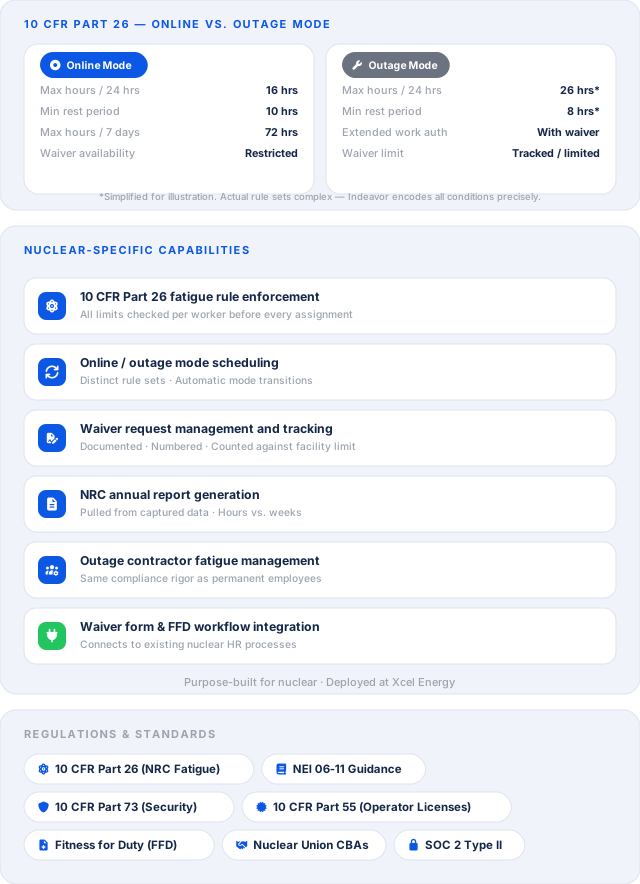
Nuclear plants operate under distinct fatigue rule sets depending on operational mode. Online operation has strict maximum hour and rest period limits. Outage mode permits extended hours with specific restrictions, waiver procedures, and reporting requirements. The transition between modes is itself a compliance event. Generic scheduling tools don't understand this distinction — and the consequences of that misunderstanding are measured in NRC findings.
Waiver management is a compliance function — not an exception process
10 CFR Part 26 waivers must be properly authorized, documented, numbered, and counted against the annual facility limit. A waiver issued without proper documentation, or one that pushes the facility over its annual count, creates a violation even if the underlying hours were operationally necessary. Manual waiver tracking in spreadsheets cannot maintain the chain of custody the NRC requires for each waiver document.
Meet Dale
Dale is an equipment operator at a nuclear station. He's 51, nineteen years on site, and the only one of four siblings who lives close enough to drive their father to dialysis. That's Tuesday, Thursday, and Saturday morning. Outage season runs twelve-hour shifts for six weeks. Both of those things are true at the same time.

What Dale wants
Outage schedules published far enough ahead to arrange rides for his father. Fatigue rules that get followed rather than waived. Overtime spread according to the agreement. And a schedule that reflects the qualifications he has spent nineteen years earning. It isn't a lot to ask. But for most frontline workers in complex 24/7 operations, it isn't how the system works.
Things happen to you.
The outage schedule still isn’t final. Dale can’t tell his sister which weekends he’ll need her to drive.
Six twelves in a row puts Dale at seventy-two hours in a seven-day window. That’s the Part 26 ceiling, and the only person counting is Dale.
He misses the dialysis run. His father waits ninety minutes for a ride.
A coworker gets the premium outage assignment Dale was qualified and in line for. Dale files a grievance.
The grievance is still open. Dale starts counting the years to retirement and wondering whether he can make it that far.
You have a say.
The outage schedule is published in the app. Dale maps his father’s rides against it in one sitting and hands his sister three dates.
NRC 10 CFR Part 26 work-hour limits are enforced in the schedule itself. Dale can’t be scheduled past his limit, so nobody has to ask for a waiver.
The supervisor runs backfill. The system ranks qualified, available operators by seniority and overtime balance. Dale’s phone stays quiet on dialysis day.
His qualifications are in the system. When a premium assignment opens, the ranking shows who was eligible and in what order.
Dale volunteers for the shifts he wants and passes on the ones he doesn’t. He’s planning for year twenty-five now instead of counting down.
How does Indeavor handle the difference between online mode and outage mode?
Indeavor treats online and outage as distinct operating modes with different staffing patterns, work-hour rules, and crew structures. Moving between them changes which constraints apply, so outage scheduling does not require a separate system or a manual reconfiguration.
How does Indeavor enforce NRC 10 CFR Part 26 at every assignment?
Indeavor applies Part 26 work-hour limits, minimum break requirements, and rolling-window rules when the schedule is built. An assignment that would exceed a covered worker's limit cannot be made, so the constraint is enforced during planning rather than discovered in review.
- Maximum hour limits checked per worker per assignment
- Minimum rest periods enforced — no workaround
- Work schedule limits applied across all covered workers
- Violation alerts before assignment — not after discovery
How does Indeavor manage online and outage mode scheduling?
Each mode carries its own staffing pattern, crew structure, and applicable work-hour rules. Outage schedules can be built and published weeks ahead against those rules, including supplemental and contract workers brought on for the outage window.
- Distinct fatigue rules per operational mode
- Automatic mode-switching at plant status change
- Outage contractor workforce management built in
- Extended hour permissions managed per outage authorization
How does Indeavor support NRC annual reporting and waiver tracking?
Indeavor retains work-hour history, waiver records, and assignment decisions as they occur. Annual reporting is pulled from that captured data rather than assembled from separate systems at year end, and each waiver carries the record of who authorized it and why.
- Annual reports generated in NRC-required format
- Waiver count tracked against facility annual limit
- Complete waiver documentation chain maintained
- Violation history documented and retrievable instantly
Qualification & Certification Management
Reactor operator licenses, SRO qualifications, health physics certifications, outage-specific credentials — all tracked and enforced at every assignment across all covered job functions.
Compliance Analytics & Trend Visibility
Real-time compliance dashboards showing pending violation risks, waiver utilization trends, worker hour accumulation, and outage workforce fatigue status — before findings materialize.
Compliance-Aware Backfill
When an operator calls off, Backfill finds the qualified replacement who is also within their 10 CFR Part 26 hour limits. No coverage solution that creates a new violation.
What results do nuclear stations see with Indeavor?
Nuclear customers report work-hour limits enforced at the point of assignment, outage scheduling planned weeks ahead rather than rebuilt daily, and annual NRC reporting pulled from captured data instead of reconstructed. Results vary by station, agreement structure, and outage scope.
10 CFR Part 26 compliance rate
Rules enforced at scheduling — not discovered later
NRC civil penalties from scheduling
Violations prevented before they occur
What nuclear scheduling requirements
does Indeavor actually handle
across both modes?
Most workforce management platforms are adapted for nuclear compliance. Indeavor was built for it — alongside nuclear operations teams at Xcel Energy and other utilities who needed a system that actually understood 10 CFR Part 26 in operational practice, not just in theory. The difference shows in how the platform handles mode transitions, waiver chains, and report generation.
-
NEI 06-11 guidance incorporated into scheduling logic
The Nuclear Energy Institute's guidance on implementing 10 CFR Part 26 is reflected in Indeavor's scheduling engine — including the specific interpretations of work period definitions, covered worker categories, and outage authorization procedures that nuclear plants operate under. -
Outage contractor workforce management
Outages bring hundreds of contractors onto the site — each subject to 10 CFR Part 26 requirements from the moment they begin covered work. Indeavor manages the contractor workforce with the same fatigue compliance rigor as permanent employees, tracking hours from day one of covered work through the end of outage. -
Integration with existing nuclear operations workflows
Indeavor integrates with waiver request forms, fatigue assessments, Fitness for Duty documentation, and other existing nuclear HR workflows — centralizing the compliance ecosystem without requiring replacement of established plant processes.
Who uses Indeavor for nuclear workforce management?
See Indeavor configured for nuclear energy.
Book a 30-minute live demo — 10 CFR Part 26 enforcement, online and outage mode scheduling, waiver tracking, and NRC annual report generation working with real nuclear facility data.
Frequently Asked Questions
Indeavor enforces 10 CFR Part 26 fatigue rules at the point of scheduling — before any assignment is confirmed. The system checks each worker’s cumulative hours within the applicable time windows (7-day, 24-hour), minimum rest period since their last shift, and work schedule limits against the applicable maximum hour constraints for their operational mode (online or outage). If an assignment would create a violation, it is blocked before confirmation. This prevents violations from occurring rather than documenting them after the fact.
Yes. Indeavor pulls annual fatigue management reports in the format required by the NRC from continuously captured data. All data — violation counts, waiver counts, documentation of each waiver event — is captured throughout the year as the system enforces compliance in real time. Report generation pulls this data in hours rather than the weeks of manual compilation that plants typically spend reconciling records. The output matches the NRC-required format without manual reformatting.
Indeavor maintains distinct rule sets for online operation and outage mode. When plant status transitions between modes, the applicable fatigue rule set switches automatically — no manual rule-switching required, no risk of applying the wrong constraints. During outages, the system also manages the large influx of contractors with the same fatigue compliance rigor as permanent employees, tracking covered work hours from the moment each contractor begins covered activities.
Each waiver request is managed with a complete documentation chain — authorization records, the specific rule being waived, the operational justification, the approving supervisor, and the timestamp of authorization. Waivers are numbered sequentially and counted against the facility’s annual waiver limit in real time. The system alerts the fatigue program manager when the facility approaches its waiver limit, and prevents additional waivers that would exceed the authorized count. All waiver documentation is retrievable instantly for NRC inspection.
Yes. Indeavor integrates with existing waiver request forms, fatigue assessment processes, Fitness for Duty documentation, and other established nuclear HR workflows — centralizing the compliance ecosystem without requiring plants to replace processes that have been validated and institutionalized. API integrations with payroll, time and attendance, and HCM systems close the loop on labor data without manual transcription.
NRC 10 CFR Part 26 governs fitness for duty at nuclear facilities, including work-hour limits, minimum break periods, and rolling-window restrictions for covered workers. Scheduling software helps by applying those limits as constraints when the schedule is built, so a non-compliant assignment cannot be created rather than being caught in an after-the-fact review.
Supplemental and contract workers brought on for an outage are scheduled in the same system as station staff, with their own qualifications and applicable work-hour rules. Because everyone on the outage schedule is governed by the same constraint engine, work-hour tracking does not fragment across the population that grows most during the outage.
Yes. Fatigue limits and collective bargaining provisions are applied together when the schedule is generated. Seniority, overtime equalization, and shift preference operate within the Part 26 boundaries, so a contractually correct assignment is also a compliant one.
Zero violations. Zero NRC findings.
Zero annual report surprises.
10 CFR Part 26 enforced at every assignment. Online and outage
mode handled precisely. Annual reports pulled from continuously captured data.
The compliance outcomes nuclear operations leadership requires.